Friday, 29 July 2011

Riding Vietnam's Ho Chi Minh trail

The mountain paths of the legendary Ho Chi Minh Trail offer visitors to Vietnam an adventurous alternative to the well-worn coastal route - especially if you travel on the back of a motorbike
Source |The Guardian,
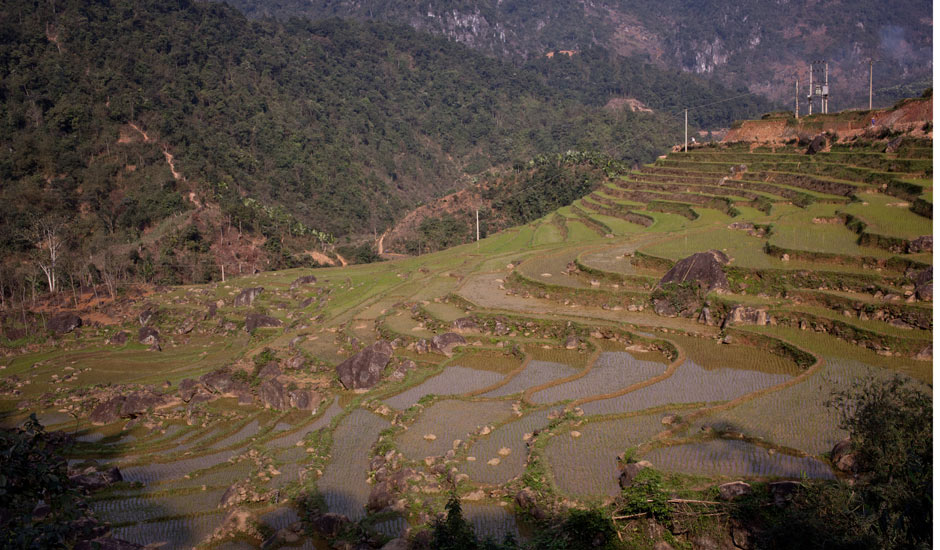
Vietnam hillside 
Rows of rice terraces are a continual feature on any ride through northern Vietnam. Photographs by Jeffrey Lau

It was more like a hamlet than a village. A simple collection of stilted wooden houses perched on the side of a mountain overlooking seemingly-endless rows of rice terraces, but even after a long and tiring day on the back of a motorbike passing through startling terrain it was hard not to be caught breathless by its isolation and beauty in the twilight.

The primitive village of Ban Hieu is inaccessible except by motorbike or on foot – it's up a long, steep and winding two-metre-wide dirt path flanked on one side by a sheer drop into the paddy fields far below. It was precisely the reason I had set off the previous day along paths once used by the Vietcong to deliver weapons and supplies to the armies fighting in the south during the Vietnam war.

The Ho Chi Minh Trail has always been the stuff of legends, a seemingly endless number of backwater paths and trails that started near Hanoi and ran almost 1,000 miles down the length of the country, crossing into Laos at several points, and ending near Saigon (today's Ho Chi Minh City) where it deposited weapons into the hands of the communist guerrillas fighting against US and Southern Vietnamese forces.

Despite intense aerial bombing the weapon caravans continued for years, and gave the Vietcong the means to continue the fight and eventually overcome the south's resistance.
Four decades later many of these paths have barely changed. Clogged with mud, they wind their way through the mountains, linking still-isolated communities and then barrelling down into the valleys through endless flooded rice fields. A dirt biker's dream, a casual rider's uncomfortable reality.

While most visitors to Vietnam travel the well-worn coastal road, I had set out the day before from Hanoi, along with a friend and our mechanic/guide, on the back of three sturdy Russian Minsks, heading south on what would be a three-day bike trip following less well-developed and at times almost non-existent roads. (This would allow me to do part of the northern section, though not enough time to complete the whole route, which takes upwards of 14 days.)

vietnamtrail 
A local rides through paddy fields in Hao Binh province, northern Vietnam

It had not started well. Within a few hours of leaving I was lying battered and bleeding on the ground, with pieces of wet gravel embedded in my skin, a bruise where my dictaphone had smashed to pieces against my hip, and the arm of my bike jacket ripped open – all a consequence of having skidded off my bike when a truck pulled out into the middle lane in front of me on the wet highway without warning.

With little chance to dwell on the fall and already far from civilisation, I had simply but shakily climbed back on the bike and, following Dang Van Diep, our smiling, non-English-speaking mechanic (who would himself tumble off his bike going down a steep mud path the following day), soldiered on.

An hour later the fall was already far from my mind as I emerged for the first time from a patch of mountain fog to look down upon the vast, green landscape of rural Vietnam stretching out before me.

The view would repeat itself regularly over the next few days (and would never cease to thrill) as our small convoy climbed and descended thin mountain paths, crossed through knee-deep rivers, and rode through dozens of isolated villages of smiling and waving children. All the while we were flanked by miles upon miles of muddy rice paddies filled with young and old women cultivating the land by hand as they and their ancestors have done for centuries.

The Ho Chi Minh Trail was once called "one of the great achievements of military engineering of the 20th century" by the American National Security Agency, but for the most part the areas the various trails pass through were and remain very rural and focused on the basic needs of living.

I soon found a simple but beautiful monotony in riding through these lush green areas, with long hours between stops passing in a meditative blink of the eye. Yet by the end of each day, as the strain of holding firm to the throttle as the bikes bounced over rock and skidded through mud, thoughts of that night's accommodation slowly crept into our minds.


Vietbikes The Russian-made motorbikes outside the homestay in the village of Ban Hieu

We spent the first night in Mai Chau, a scenic village without roads 135km from Hanoi that is quickly being discovered by tourists looking for somewhere off the beaten path. By the following day we'd left the tourists behind and had only the simple, smiling silence of Diep for guidance and company. That night, after 10 hours on the bikes, we arrived at the truly isolated Ban Hieu.

As I dismounted unsteadily from my bike outside the small stilted home we were staying in for the night and went to dunk my head in the nearby stream to wash away the sweat and mud of the day I was stopped in my tracks by the view in front of me.

A village of a few dozen families, an hour by motorbike from the nearest community with a shop, and inaccessible by car, it felt like a forgotten land. The manmade rice terraces – irrigated by intricate bamboo piping snaking down the hillside – and other human intrusions all felt in harmony with nature, and in the miles upon miles of land spread out before us, no city, town, or even single human dwelling was in sight.

Our smiling hosts were already pouring hot water for us and preparing food and beds for the night as I returned.

Despite having no common language, the extended family was soon showing us pictures of their children, away at school, and their grandparents, long deceased, who would have been alive when the Vietcong passed through on their way south. The guerrillas may have even stopped, like us, for hospitality for the night, staying in homes not much different from the one we now found ourselves in.

With the light fading outside it was hard to stay awake and I stretched out on one of the mattress laid out on the floor, searching for a comfortable way to sleep without lying on my bruised shoulder and hip.

The following day at dawn we started our journey back north, reaching the noisy and crowded streets of Hanoi by nightfall. Despite one bad fall, aching limbs and over 300-plus miles of dirt trails on the back of a relic of the Soviet Union, it was hard not to turn the bike around and head back out to continue down the trail southwards.

• Hire motorbikes and all-inclusive organised tours can be arranged through tour companies such as Explore Indochina (
exploreindochina.com) and Ride Ho Chi Minh Trail (ridehochiminhtrail.com), with organised tours from around $100 per person per day

Boehner Delays House Vote on Plan to Raise Debt Ceiling

Stephen Crowley/The New York Times
Speaker John A. Boehner,  flanked by Republican members of the House of Representatives, urged fellow House members to pass his debt ceiling bill on Thursday.
WASHINGTON — House Speaker John A. Boehner abruptly delayed an expected vote on Republican debt ceiling legislation late Thursday as it became clear the Republican leadership did not have the votes needed for passage. Immediately after the vote’s delay, Republican members could be seen streaming in and out of the Speaker’s office as Mr. Boehner continued to work to win their support for the legislation.
Representative Louie Gohmert, Republican of Texas, who had been opposed to the legislation, emerged from Mr. Boehner’s office to say that the Speaker had once again pressured him to switch his vote.

Mr. Gohmert told reporters that he remained opposed but was now "a bloody, beaten-down ’no.’ ”

The postponement came as lawmakers had nearly finished discussing legislation that would set up a pivotal showdown between the House and the Senate over how to cut spending and increase the debt limit before the Aug. 2 deadline when Treasury Department officials have said the country will run out of authority to borrow money.

As the backroom arm-twisting went on, the House killed time by moving to a series of minor bills naming local post offices from New Jersey to Guam.

Mr. Boehner had spent two days furiously lobbying freshman Republicans for his plan, which would cut federal spending by $917 billion and provide enough borrowing authority to keep the government solvent until January. But Senate Democratic leaders said that they would waste no time rejecting the legislation if it included the short timeline.

In four hours of debate leading up to the expected vote, Republican lawmakers described the bill as the only legislative compromise that can keep the country from defaulting on its debt next week.

“We must act today, approve this bill, and balance the budget for future generations,” said Representative Jeb Hensarling, Republican of Texas.

Democrats, though, called the bill an abdication of responsibility that would force a second gut-wrenching debate about the debt ceiling in an election year.

“It’s high time that we stop playing Russian Roulette with the American economy and with American jobs,” said Representative Chris Van Hollen of Maryland, the senior Democrat on the House Budget Committee.

Legislative maneuvering had become intense on Capitol Hill Thursday as lawmakers in both chambers and in both parties sought to game out a procedural advantage in the days left before the debt ceiling deadline.

There was no immediate reaction from the White House, where officials mindful of the countdown to Aug. 2 scrambled to find out when a House vote might be rescheduled. Though Mr. Obama had threatened to veto the House bill, officials were concerned about it being shelved again given that it would delay the effort to reach an ultimate compromise.
Leaders of both parties and in both chambers said that it was essential to avoid a default on the federal debt, but that was practically all they agreed on.

Before the delay, the Senate majority leader, Harry Reid of Nevada, said Senate Democrats would move immediately to set aside the House proposal if it wins passage and then take steps to force a vote on Mr. Reid’s own proposal to raise the debt limit through 2012 in exchange for more than $2 trillion in cuts.

“No Democrat will vote for a short-term Band-Aid that would put our economy at risk and put the nation back in this untenable situation a few short months from now,” Mr. Reid said.
But the House Republican leaders said that would put blame for the continuing crisis on the Senate Democrats.

“When the House takes action, the United States Senate will have no more excuses for inaction,” Mr. Boehner said, just before taking his bill to the floor.

“Is this as much as I want? No,” Mr. Boehner told his fellow Republicans. “But it advances our goals and doesn’t violate our principles.”

The White House spokesman, Jay Carney, said that a successful compromise would ultimately have to include not only significant spending cuts, but also a commitment to revamp the tax code and entitlement programs like Social Security and Medicare, and a debt ceiling increase generous enough to last through next year without a reprise of the standoff.

He conceded that the chances were “not great” for a grand compromise before Aug. 2, which the White House has insisted is the deadline for extending the debt ceiling for paying the nation’s bills.

On the House floor, there were some Democrats who continued to call for including some kind of tax increase, like letting the Bush-era tax cuts for the wealthiest Americans lapse, but no matter how events unfold in the days ahead, that seems the unlikeliest of outcomes.

Cairns lawyer appointed to Supreme Court


PROMINENT Cairns barrister Jim Henry SC has been named Justice Stanley Jones's successor as Far Northern Judge of the Supreme Court of Queensland.

Mr Henry, who will replace Justice Jones on September 12, told The Cairns Post he was looking forward to taking up the challenging role.

"I am honoured by the appointment and very conscious of the great trust and responsibility it bestows upon me on behalf of the community," he said.

"It is particularly pleasing to be a Supreme Court appointee drawn from the ranks of Far North Queensland’s own local legal profession.

"I am humbled to be appointed as successor to the current Far Northern Judge, the Honourable Justice Jones AO, a great jurist who has served our community with distinction over many years."

Since his admission as a barrister in 1986, Mr Henry has had an extensive and varied legal career that has included stints with the Director of Public Prosecutions in the Far North and the Gold Coast.

In July 2000, he moved into private practice in Cairns and was appointed a Senior Counsel in 2006. Attorney-General Paul Lucas said Mr Henry’s experience held him in good stead for the appointment Mr Lucas also paid tribute to Justice Jones, who retires after 14 years as the Far Northern Judge on September 10.

Author | Source | Melanie Petrinec | Friday, July 29th, 2011
© The Cairns Post


Cairns Show manager stood down


Gavin King
Friday, July 29, 2011
© The Cairns Post

Cairns Show general manager Alison Stickens has been stood down and could be sacked by the show committee just days after she delivered a record-breaking event.

Ms Stickens, who has been show manager for the past four years without any previous complaint or issues being raised, was told of the committee’s decision at a meeting on Wednesday.

The reasons given for the committee’s decision included that she was difficult to contact during the show and that she did not get along with all of the 32 members of the management committee.

She has vowed to fight the decision and has engaged a solicitor and a representative from the Australian Workers’ Union to take on the management committee.

Show committee president Ian Allen said a vote would be held at a meeting today to decide if Ms Stickens is dismissed. He declined to comment further, only saying the committee was "unhappy with her performance".

Ms Stickens, who is also a director of the state’s peak show group Queensland Chamber of Agricultural Societies, said she was shattered by the sudden news. A record crowd of 80,088 people attended last week’s Cairns Show, the biggest in its 120-year history.

"I’m just devastated, I give 110 per cent every year and I just can’t understand where this has come from," she said.

"I’ve got support from all stakeholders, I’ve got great relationships with the sponsors and the media and all the staff, and the committee has never raised any issue or concern with my performance over the past four years.

"I’m going to fight to get my job back because they have not followed due process or workplace law."

Queensland Chamber of Agricultural Societies chief executive Mark Bryant, who was general manager of Cairns Show for three years before Ms Stickens took up the role, said he was concerned about her sacking.

"The Cairns Show is an extremely important part of the Cairns calendar so the community must come first and we’d be concerned if any problems arose in the running of the event," he said.

"I’ve never had any problems with Alison’s performance over the years I’ve had dealings with

Thursday, 28 July 2011

Alan Jones tells activist group GetUp to 'get stuffed' over complaints to broadcast watchdog

Alan Jones
Radio personality Alan Jones Picture: Anthony Reginato Source: News Limited

Talkback radio host Alan Jones has told political group GetUp to "get stuffed" as it pursues a complaint against him with the broadcasting watchdog.

The Australian Communications and Media Authority (ACMA) has been asked to investigate comments about man-made carbon dioxide that Mr Jones allegedly made in March while broadcasting his popular morning program on Sydney's 2GB station.

GetUp said it complained to ACMA because Mr Jones said human beings produce 0.001 per cent of carbon dioxide in the air.

Mr Jones today denied ever having made the comment and said the complaint was politically motivated. "I never said that at all," he told AAP.

GetUp called for Mr Jones to issue an on-air correction of the alleged statement. "We'd certainly like to see Mr Jones correct this incorrect statement," spokesman Paul Mackay said.Mr Jones responded: "Tell them to get stuffed. "Who are Getup? What credibility do these people have? Nil. "Other than they've backed the Labor Party."

Asked what his reaction would be if ACMA found in GetUp's favour and demanded he made an on-air correction, Mr Jones replied: "Good luck, we don't frighten easily.

"This is intimidatory stuff that's being practised everywhere because they're backed into a corner." Mr Mackay said GetUp was happy ACMA had taken up the issue.

"Very, very much so. It's good ACMA's acting in this way and so they should," he added.

"We're after fair reporting in any instance. This is why ACMA was created, to make sure these sorts of misstatements aren't broadcast or if they are, people have to make an apology or stand by them."

ACMA confirmed it had launched an investigation regarding Mr Jones but would not disclose any of the terms of reference, details of the complaint or who filed it.

Author | Source

Wivenhoe Dam releases more than half of flood in Brisbane River

Wivenhoe Dam
Queensland's Wivenhoe Dam. Source: The Courier-Mail


Releases of water from Brisbane's Wivenhoe Dam during the devastating January floods comprised more than half of the total flow volume in the lower Brisbane River, according to a new report by the independent hydrological expert commissioned by the Floods Commission of Inquiry.


The report by Mark Babister states that its findings support recommendations that "alternative (Wivenhoe Dam) gate operation strategies for flood mitigation should be reviewedfor a full range of flood events".Mr Babister has previously highlighted flaws in the official manual for the operation of the dam'

The report states that complex hydraulic modelling "highlight that for this event, earlier increases in releases from Wivenhoe Dam during 9 and 10 January could have reduced the eventual peak outflow and the resulting severity of flooding experienced downstream".

But the report, which does not criticise the dam operators, also stresses that with the information available during the operations of the dam and using the strategies defined by the manual, the flood engineers achieved close to the best possible mitigation result.

The report states: "If full foreknowledge of the dam inflows is available, the dam releases can be optimised to reduce peak discharge from the dam. Under this scenario, the peak outflow of Wivenhoe Dam is reduced (by about 40 per cent) from 7500 cubic metres a second to 4500 cubic metres a second."

It adds that such a scenario was implausible "as it relies on using discretion to increase discharge from Wivenhoe Dam above allowable thresholds" and "would have relied on foreknowledge of the large second inflow peak into Wivenhoe Dam".

In the weeks after the flood the Wivenhoe Dam's supply of water for drinking was drained to 75 per cent to give the dam more capacity in the event of a follow-up major rainfall event.

Mr Babister's report found that if Wivenhoe Dam had been at 75 per cent prior to the flood, either through policy or predicted rainfall conditions, there would have been a benefit "in a reduction in total flood volume released from Wivenhoe Dam (about 11 per cent lower) and a reduction in the peak discharge from the dam from 7500 cubic metres a second to 5200 cumecs (about a 30 per cent reduction).

"If gate operations were revised to take advantage of the additional storage available under such a scenario, it is expected that the benefits on flood levels would improve further although such scenarios have not been investigated here due to time constraints," the report states.

However, it adds: "Care must be taken with interpreting these findings, which are based on a single large flood event, in relation to the effectiveness of the strategies in the manual for dealing with future events, some of which will be larger."

The report found that near the peak of the flood event at Jindalee, about 15km west of Brisbane, the Wivenhoe Dam's flows comprised about half of the total flow measured by gauging of about 10,000 cubic metres a second.

Mr Babister tested several different scenarios during a complex hydraulic modelling review and found that alternative operation of the Wivenhoe Dam could have taken almost a metre off the flooding at Moggill and Jindalee, and about half a metre off the flooding in Brisbane.

He found that the Wivenhoe Dam peak flows, at the confluence of the Brisbane River and Ipswich's Bremer River, "occurred near simultaneously with Bremer River peak flows" and that as a result there was "significant backwatering of the Bremer River" to a distance of about 15km upstream.

"Ipswich flood behaviour is sensitive to backwater from Brisbane River flooding, caused by flows from either Wivenhoe Dam releases or other catchments below the dam. The exact additional flood height at Ipswich due to dam releases during the January 2011 event cannot however be ascertained with the current model.''

The Floods Inquiry's interim report to be released next week will include findings that the manual is not fit for purpose. The interim report is also expected to include criticism of the performance of senior bureaucrats, politicians and others involved in the management of Queensland's flood mitigation strategies.

One of the major criticisms of the Queensland Government and SEQWater after the flood has been that the dam's operators held too much water for too long until it was forced by continuing and heavy rainfall to release so much water suddenly that the flood became inevitable.

Author  | Source |

 My View

'It may well come to pass that the Brisbane flood of 2011was a man made phenomenon created by human panic as a result of previous inept government decisions; the lack of adequate infrastructure during the Beattie premiership.

It will be recalled that Wivenhoe Dam was built as mitigation Dam following the Brisbane flood of 1974. The Bjelke -Petersen Government did not want to get caught again without a flood mitigation structure on the upper reaches of the Brisbane River and fast tracked the construction of the Wivenhoe Dam.

Notwithstanding Beattie's Government 10 year popularity, it did little about building adequate public infrastructure in the South East . Water supplies, roads networks and other government services were all put into the too hard basket...lots of plans, forward strategy and bureaucratic process but no money to put the plans into action with a building programme.

As a result the original purpose of Wivenhoe Dam changed from a flood mitigation dam to a dam for the storage of water for Brisbane. As a result of this change of priority the Wivenhoe Dam's water had to be preserved for domestic use as the Government did not want to face another period as it did in the 2007/2008 when Brisbane in particular was on sever water restrictions.

If the Government had governed instead of sitting on its collective hands and spinning its way out from one crisis to another and kept pace with the infrastructure including adequate water reticulation, Wivenhoe Dam could have been near empty with the onset of 2010/11 wet season instead of near full capacity.

I believe the State Government may be skating on thin ice and the culpability of the Government will depend on the Floods Iinquiry's findings. If it comes down with adverse findings the possibility of a class action may exist with momentous implications for SEQWater and the State Government not to mention the state election due in 2012.'

USSS Blue Ridge docks in Cairns

THE USS Blue Ridge sailed into Cairns yesterday and its 1000-strong crew are set for a tropical break and ready to give back to the region.


American flags are flying around the city and tourism leaders said the six-day stop-over would bolster the region’s reputation in the US with "1000 advocates" posting photos on Facebook and tweeting about their experiences.

While many are on shore leave after the joint Australian-US Talisman Sabre military exercise, some sailors and marines will be lending a hand to clear debris from areas devastated by cyclone Yasi. The 40-year-old US command warship, which weighs 20,000 tonnes, is 194m long and has 13 levels, docked in port about 7.30am yesterday.

Within hours a steady stream of sailors – changed into their civvies – were on the way to the city, to relax, sightsee or have a beer, with some even splurging on a hotel room to get away from life at sea.

And Cairns businesses were banking on a million-dollar boost for the local economy.

The ship’s commanding officer Capt Dan Grieco said the Japanese-based families of some personnel had met them in Cairns to holiday and many others had booked hotels, Reef tours and planned to see a pub or two.

"They are very excited to come and be out, with the fun of the port," Capt Grieco, who is on his first trip to the city, said.

But there is still time to lend a hand with 30 sailors on a working bee at the Cairns Legacy widow’s home yesterday and others heading to Tully today.

"It’s an opportunity for the crew to give back as well, which they very much enjoy," Capt Grieco said.

US deputy chief of mission Jason Hyland said Cairns was a "much sought after liberty port" for sailors.

The USS Blue Ridge is the "brains" of the Seventh Fleet – the biggest in the US navy – and was charged with command, communications and control of the fleet’s 70 ships.

Tropical Tourism North Queensland chief executive Rob Giason said the stopover was a great opportunity. "It is a great opportunity to have 1000 advocates for tropical North Queensland here on shore leave who will promote our region by posting photos on Facebook, tweeting to their followers and telling family and friends about their wonderful experiences here," he said.

"The 1000 recommendations will help the US market understand what this region is all about."

Cale Hatch, 21, has been on the ship for more than two years and said the travel was the best part of his job, although sharing a berthing with 84 other men was something he was still not used to.

Ashley Laws, also 21 and from Texas, was one of about 120 women on the ship. This is her second trip to Cairns.

She said the ship could be "rocky" and days at sea could be arduous, but now she is on dry land, she planned to relax at Palm Cove and visit a zoo while in the Far North.

"I like the responsibility, it’s good to be part of something bigger than just yourself," she said.

Author |  Source
Kelly Burns
Thursday, July 28, 2011
© The Cairns Post

Summer in Europe | 10 days out for kids

The school holidays are well under way, and if the kids are driving you mad, check out our latest events and activities for children, from enchanted princesses to electric guitars
summermancester
Far, far away at Manchester Art Gallery

Far, far away, Manchester


From 2 August, the normally hushed rooms of Manchester Art Gallery will be disrupted by the squeals of children as they discover a fantasy world of princesses and knights. Set over the two top floors of the gallery, the transformed space will include three tents where kids under 12 can create costumes and make films of their stories to project on to the gallery walls. Artists will also be on hand to organise art activities, and there will be sensory play areas for babies and toddlers.
•
manchestergalleries.org. Free, 2-28 August, Tuesdays to Sundays, 1-3pm

Bike It, nationwide


Britain has 13,000 miles of walking and cycling routes, among them plenty of short, traffic free ones suitable for children. UK charity Sustrans is promoting its best family-friendly routes as part of its Free Range Kids campaign, aimed at ensuring future generations of independent, active children. The routes include the Spen Valley Greenway, near Bradford, a 5½-mile route along the River Exe in Devon and a nine-mile ride into the heart of the New Forest with Holmsey tearooms providing a handy pitstop. Or get a breath of sea air on a five-mile ride from Frinton to Clacton in Essex, building up an appetite for fish and chips.
•
sustrans.org.uk

Steam fair and vintage vehicle rally, Somerset

Sometimes the old ones are the best. A nostalgic day out is on the cards at the West Somerset steam fair and vintage vehicle rally held at Norton Fitzwarren, near Taunton, on 6 and 7 August. Steam engines, fire engines, tractors, steam rollers and buses will be on display, giving kids the opportunity to ride them and witness the huffing and puffing of the engines, not to mention all the fun of a fair(ground).
•
west-somerset-railway.co.uk. 10am-5pm each day, adults £8, children £4, family ticket £20

Traquair Fair, Scotland

summerfire


Traquair Fair, held in the grounds of Traquair House on the Borders on 6 and 7 August, is one of Scotland's longest-running fairs, offering theatre, outdoor spectacles, music, dance, storytelling. This year's theme is fire, and so there will also be flame-eating, glass-blowing demonstrations, forging and pottery-making. Included in the ticket price is a tour of the house, which dates from 1107 and was a hunting lodge for the kings and queens of Scotland. Bed and breakfast accommodation is available in the house (doubles £180), or you can camp in the grounds.
•
traquair.co.uk/content/traquair-fair. Adults £19 booked online, children over five £13, family ticket £46

Record-breaking, Carmarthenshire

The Campbell family, famous for breaking land and water speed records in the 20th century, celebrate the centenary of their Bluebird car this year, and are showing no signs of slowing down. On 13 and 14 August, Don Wales, grandson of Sir Malcolm Campbell, will attempt to break his own electric land speed record of 137mph, as he aims for 150mph on a four-mile stretch of Pendine Sands in Carmarthenshire, where his grandfather set the world land speed record for the first time in 1924. With high adrenaline and fast cars, this will be an exciting weekend, with speed trials for the 500mph land speed attempt taking place, too.
•
bluebirdspeedrecords.com. Free. Record attempts 3pm on Saturday and Sunday


School of Rock, Brighton


summerrock


Kids might balk at the idea of going to school in the holidays – unless it's the School of Rock. The Brighton Institute of Modern Music (Bimm), which runs rock'n'roll colleges in Brighton and Bristol, has teamed up with Total Guitar and Metal Hammer magazines to offer three courses in August. The Total Guitar summer school (1-4 August, limited availability) covers artists from Bloc Party to Eric Clapton, with tutors including Paul Weller. The Skindred-to-Black Sabbath Metal Hammer school is from 8-11 August.
•
bimm.co.uk. £299 for four days, accommodation extra (local B&Bs from £25 a night), over-12s only, not suitable for absolute beginners 

Wild Weekends, Staffordshire

Any budding Bear Grylls needs to learn survival skills before they embark on a perilous journey into the wilderness. A Wild Weekend on 6-7 August at Trentham Estate, near Stoke-on-Trent, will prepare your intrepid explorers by teaching them to use a selection of hunting tools, stalk their lunch, use a compass and make camouflage using natural materials. They will then get the chance to put these skills into action on navigation courses set up around the estate, culminating in a gruelling "circular challenge". Parents in search of some peace could head to the Trentham Gardens, described by Alan Titchmarsh as "one of the UK's must-see gardens."
•
trentham.co.uk. Wild weekend 10am-2pm each day, no booking necessary. General admission adult £7.75, child 5-15 £6.50, family £26.50


Mr Stink, Salford and Nottingham


Written by Little Britain star David Walliams, this children's musical is literally causing a stink. It is described as Britain's first scratch n' sniff production, and children are given a booklet that they are encouraged to scratch and sniff at key points in the show. Despite an abundance of farts, belches and smelly socks, a touching tale emerges of 12-year-old Chloe, who is bullied at school and ignored at home. She befriends homeless Mr Stink and his dog, Duchess, but is met with opposition from her snooty, air-freshener-wielding mother.
•
mrstinklive.com. 2-14 August, The Lowry, Salford Quays, from £16.50 (0843 208 6000, thelowry.com/theatre. 16-28 August, Nottingham Playhouse, from £11 (0115 941 9419, nottinghamplayhouse.co.uk). Touring to November

Gruffalo Day, Norfolk

Legend has it that the sleepy county of Norfolk is home to one of the most infamous characters in children's literature – the Gruffalo. Holkham national nature reserve will be holding a storytelling session on 5 August to mark Gruffalo Day, inspiring kids to explore its 4,000 hectares in pursuit of the grizzly creature, along with other rare species including natterjack toads, barn owls, marsh harriers, lapwings and the monstrous-sounding garganey, which is in fact a harmless rare species of duck. The reserve includes sand flats, sand dunes, saltmarshes and woodland and offers beautiful views of the coast.
•
naturalengland.org.uk. Free, Beach Road, Wells-next-the-Sea

Championsheeps, Bristol


summerbristol


Walk through a tornado, take a trip to the stars, frolick in a farmyard - the kids could do all this without having to even leave the country, at At-Bristol, a science centre with 300 interactive exhibits. From July 30 to August 31, Shaun the Sheep and his friends will be at the centre, putting families through their paces with their "Championsheeps" events including a farmyard assault course, sack races and Shirley-shaped sheep hoppers. Elsewhere, the Boggling Brain show (twice daily, free) focuses on how our brains make sense of the world, and storyteller Hannah Broadway will bring her Monkey and Robot books to life from 1-3 August.
•
at-bristol.org.uk. adult £12.50, child 3-15 £8, family £35.50, Championsheeps places £1.50pp

Author | Source | Nalini Sivathasan | The Guardian, July 27th

Gillard and friends move from GetUp to shut up

Lately the Gillard government has been clothing itself in GetUp! attire, but last week it flirted with adding some ShutUp accessories.

The problems started when the political agenda of this government started to sound remarkably like the agenda of the far left special interest group GetUp!

It's a world view that allows you to believe democracy is a sufficiently malleable principle that you can barefacedly lie to the voters and not pay a big price. (How many billboards have you seen GetUp!, that self-styled protector of democratic values, pay for condemning Julia Gillard for lying to the voters? That would be zero, right?)

I suspect I'm not revealing any state secret when I say the political policy positions of GetUp! -- reeking of po-faced pieties and "We are the World" platitudes -- are distinctly minority ones. If this becomes your core support group as a government then you are in big, big trouble. Which is when Gillard moved from GetUp! to ShutUp.

Apparently the thinking is that we have too much free speech here in Australia. Maybe we ought to pick up on the great democrat Bob Brown's musings and go back a few centuries so we can regulate what the press says.

But putting all the siren song supporters of privacy laws to one side (and we can all await with eager anticipation the next GetUp! billboard in support of this latest thought-bubble policy creation), here is what is at stake.

Any new privacy law regime will make inroads on what people can say. It will take some speech off the table. There is an inevitable trade-off between free speech concerns and privacy concerns. If you shift the goalposts in favour of more privacy, then by definition you place more limits on free speech.

And I think that's a terrible idea. First off, our laws are already easily sufficient to handle phone hacking situations of the sort engulfing Britain at present. So that's a red herring, plain and simple.

Second, more aggressive privacy laws work not simply by allowing people actually to sue. They work also by creating an atmosphere where people censor themselves because they are afraid of being sued, precisely in the same way that our terrible hate speech laws at present over-reach.

Just look at France, which has strong privacy laws. You had an atmosphere there, no doubt also culturally influenced, where the past exploits of Dominique Strauss-Kahn came as a surprise to most people, save reporters. Do you think those exploits, and I explicitly assume that the New York City charges against him will collapse, but do you think his behaviour might influence whether some people voted for him?

Tony Abbott should have no part in this ShutUp agenda. In any contest between free speech and privacy I think long-term best consequences favour the former much more often. Certainly our present status quo needs no rebalancing in favour of more speech restrictions, and that's true even if it's sold under the banner of some human right to privacy, with a few perfunctory references to international treaties.

Amazingly, however, our present GetUp!/Gillard government seems to think a new ShutUp agenda may help it out with the voters. You have to wonder what planet it inhabits.
We can all only watch this train wreck of incompetence with incredulity. From GetUp to ShutUp, the whole thing has been one giant F . . kUp.

Author | Source | James Allan is Garrick professor of law at the University of Queensland.

Hendra Virus | Family battles to keep best mate


Hendra Queensland
Liz and Neil Fearon on their farm at Mount Alford.
The owners of the first dog to test positive to Hendra virus won't put down their pet until the infection is confirmed in a third round of testing.

Neil Fearon said his family had already lost three horses to the flying fox-borne disease, and saving antibody-positive kelpie Dusty would be to the benefit of science, as well as the family.

The family of four, including two boys, is baffled as to why the animals became infected with the potentially deadly virus.

"This is the young fella's best mate, and for us to put him down is going to be a real struggle," Mr Fearon said, referring to his 11-year-old son.

"It's hard to explain to a boy who is not even 12 why his healthy best mate has to be put down."

As he spoke, choking back tears, the two-year-old kelpie cavorted at his feet.

The family dug in yesterday as Queensland Premier Anna Bligh and her NSW counterpart, Barry O'Farrell, agreed to contribute an additional $6 million for research into the disease, and the development of treatments.

Speaking at the gate of his quarantined property at Mount Alford, 80km southwest of Brisbane, Mr Fearon said the family had reluctantly accepted that Dusty could be a threat to their health, and would have him euthanased if the latest samples were positive.

The initial round of tests was negative, but more sophisticated screening at the CSIRO's Australian Animal Health Laboratory detected Hendra antibodies in the dog's blood. However, he is not infectious nor showing any sign of illness.

Mr Fearon said he was mystified as to how Hendra had spread on the property when there was little to attract fruit bats. He had seen none of the creatures since pulling up a grove of banana trees six years ago.

Dusty is the first dog known to have contracted the virus in the field, which was previously confined to flying foxes, horses and humans. Biosecurity authorities believe he was infected by one of the horses on the property.

Yesterday, a joint NSW-Queensland meeting of medical and scientific experts met to discuss the escalating emergency, which involves 11 outbreaks from far north Queensland to northern NSW. The eruption of Hendra is unprecedented in its geographic spread and viral load in flying foxes, and the discovery on Monday that it can infect dogs.

Queensland's chief veterinary surgeon Rick Symons said biosecurity staff had explained to the Fearons it was national policy to euthanase an animal with a positive test for Hendra virus. "The decision has not been made, but the policy is -- it was confirmed at a national conference -- and it is to put it down," he said.

Biosecurity Queensland principal veterinary epidemiologist Hume Field said the spike in cases may be linked to summer rains.

Federal MP Scott Buchholz, whose sprawling southern Queensland electorate includes three areas affected by Hendra, said Dusty should be spared while he was asymptomatic.

Author | Source | Rosanne Barrett | The Australian, July 28th | Picture: Lyndon Mechielsen. 

Amy Winehouse: The last days of the good-time girl who did not want fame

Amid the chaos of the final weeks of her life, Amy Winehouse could still be entrancing, writes Alexandra Topping


Amy Winehouse
 
 
Amy Winehouse: 'her death, like her life, has been lit by the glare of dozens of camera flashes'


Sitting on the bar after closing time in her local in Camden, the lights dimmed and the doors locked, Amy Winehouse knew how to hold an audience, even before she became famous. After a night of drinks and laughter, she would perch her tiny frame on the bar, take up a guitar and sing.

"Everybody would just stop and be entranced," said Dougie Charles-Ridler, co-owner of the pub and long-time friend of the singer. In those days, Winehouse was a good-time girl with a big mouth and an attitude to match. "I remember when I first met her I asked what she did and she just said, 'I'm a jazz singer,' he said. "No one had ever given that response before."

But the picture friends paint of the woman she became is suffused with a different type of light. No longer able to chat to old friends undisturbed, or throw herself behind the bar to serve a few lucky punters, she would go into the pub on her own on a Monday or Tuesday, often in the quiet of an afternoon, stand in front of the jukebox and turn it up loud.

"Recently she'd always be with two bouncers rather than two friends," said veteran lads' mag journalist Piers Hernu, who had known Winehouse through friends and the Camden scene for years. "People wouldn't go up to her any more, she wouldn't talk to people. She just became increasingly alienated from her own world." She was alone, it seems, for the last night of her life.

 During his 40-minute eulogy at her funeral on Tuesday her father, Mitch, said the singer had stayed in her Camden Square townhouse. After seeing a doctor for a routine appointment at around 8.30pm, she played drums and sang into the early hours, until her bouncer told her to keep it down. He heard her footsteps overhead for a while, then it went quiet. When he went to check on her in the morning she appeared to be sleeping, and it was only after checking again at 4pm on Saturday afternoon that he realised she was dead.
How she died remains unclear.

A postmortem examination carried out on Monday proved inconclusive and, from the information released so far, the days leading up to her death seem relatively uneventful. On Friday she saw her boyfriend, the film director Reg Traviss, and they talked about the wedding they were going to. Winehouse was trying to decide what to wear. Her mother has said that at lunch on the same day the singer had seemed "out of it", but they had spent an enjoyable day together and among the last things her daughter had said was: "I love you, Mum."

On Wednesday, the last time Charles-Ridler saw her, she seemed in good spirits. "She jumped into my arms – she hardly weighed anything – and wrapped her legs around my waist," he said. Asking the singer if she was all right, he received a response that was typically Winehouse. "'Course I am, darlin'," she said, and walked off like Eric Morecambe.

The same night she made a surprise public appearance with her godchild, the 15-year-old soul singer Dionne Bromfield, at the Roundhouse. The video if not painful, is uncomfortable viewing. Winehouse comes on stage and lifts Bromfield up with the force of her embrace. Then, dressed in skinny jeans and a black polo T-shirt she dances sporadically, turning to the drummer, laughing and turning away. When Bromfield briefly holds the microphone to Winehouse's mouth, she does not sing.

Some of Winehouse's appearances this year held promise for those desperate to see the singer back to her Grammy-winning best. During a five-date tour of Brazil in January, some performances, such as a rendition of the Moulin Rouge song Boulevard of Broken Dreams, gave a tantalising glimpse of the talent that had been obscured for many years.

Then, after another stint in rehab in early June, Winehouse played a seven-song set to a small group of family and friends at London's 100 Club on 12 June. She was "coherent" and "back on form" according to according to one observer, while Mitch Winehouse, during his eulogy, called it a great night. "Her voice was good, her wit and timing were perfect," he said.

But then, just six days later, painfully, dramatically and very publicly Winehouse came tumbling off the wagon. On the first night of a "comeback" tour of Europe in Belgrade she appeared on stage an hour late. Visibly drunk, she seemed barely able to remember the lyrics she had written and was finally booed off stage by fans who had just wanted to hear her sing.

Days later her management cancelled the 12-date tour, saying the singer would be given "as long as it takes" to sort herself out. "Everyone was absolutely gobsmacked," a source close to the management told the Guardian. "The hotel had been told to remove all traces of alcohol, but what can you do? She is a 27-year-old woman and if an addict wants to get hold of alcohol, they will do."

Questions were asked about why Winehouse was touring, and why she had gone on stage, but those close to her had every reason to think she was "back on track" professionally, the source added. "There was no reason to expect a disaster, things had seemed on the up."

In recent days Raye Cosbert, Winehouse's manager from the Metropolis management company, and the co-president of Island Records, Darcus Beese, have taken pains to swat down reports that the shambolic performance had created a rift between them, issuing a statement saying they had always stood "shoulder to shoulder" to give Winehouse "our total support and all the love her huge talent and wonderful human spirit deserved".

But while few doubt that everyone in Winehouse's entourage – label, management, family – were doing their best to help her recovery, a source close to Universal, Island's mother label, said that after seeing the Serbia performance: "Everybody was shocked she was doing anything. It was very odd to us. Obviously it didn't help, it couldn't have."

Mitch Winehouse said this week that his daughter had been off hard drugs for three years, and was trying to tackle the alcohol problems that were so painfully apparent in Serbia.

"People focus on the drugs, but the biggest problem was Amy's alcoholism," said Hernu. "It had the worst effect on her little frame. It basically gave in."

Winehouse's addictions – whether to drink, or the harder drugs that seemed to control her life for years – have been played out in the public arena. The photographic documentation of her demons appear even more ghoulish now: Winehouse with her trademark black eyeliner swoops smeared across her face, her pink ballerinas caked in blood and dirt and her then husband Blake Fielder-Civil's face covered in scratches in 2007; barefaced, distressed and wearing only a bra and jeans the same year.

And her death, like her life, has been lit by the glare of dozens of camera flashes. At the messy and makeshift shrine outside Winehouse's home, with its vodka bottles and cigarette packets, flowers and portraits, some fans cried. Others took oddly awkward photographs of themselves outside the place where she spent her last hours.

One fan, waiting to watch her coffin go past outside Golders Green crematorium on Tuesday, said the incessant coverage had pulled fans closer to her. "We saw her deterioration every day, in every picture," said 18-year-old Amy Swan. "It was like we were on a journey with her. So many people just wanted her to get better."

But there were others who wanted her to play up to her hellraising image.

Musician Liam Bailey, who became friends with Winehouse after she signed him to her own label Lioness Records, described going to a Pete Doherty gig with her last year. "I was gobsmacked by the attention," he said. "There were people offering her drinks, saying they loved her, other people throwing stuff, saying things I don't want to repeat. And all the time the bullying from the paparazzi was horrendous."

Propping up the bar at the Hawley Arms, not a seething den of iniquity but rather a tastefully decorated, candle-lit pub with a rock'n'roll edge, Charles-Ridler said Winehouse could find no respite from it. "She couldn't go anywhere, it was always in her face," he said. "And she was the most anti-fame person. She could play in front of 60,000 people and then be in here, and much happier, pulling pints the next night."

The fact that she could no longer do that added to her isolation, said Hernu. "Coming back to England, London and more specifically to Camden didn't seem to work for her," he said. "She couldn't do what she loved which was bouncing around Camden talking to everyone. She was bored and she was lonely."

The analysis of what caused her eventual demise, on Saturday 23 July, aged 27, will be dissected minutely over the coming weeks. But, said Charles-Ridler, those who peered into her life should also take a moment to look at their own.

"Yes she did this to herself, yes she was self-destructive, but she was a victim too," he said. "We all have to take a bit of responsibilty, us the public, the paparazzi. She was a star, but I want people to remember that she was also just a girl."

Author | Source | Alexandra Topping | The Guardian, July 27th |Photograph: Matt Dunham/AP